What We Are Hearing
What has changed since May, and what it means for manufacturers, retailers and distributors
Cost pressure did not go away. It settled in. The uncertainty that froze decisions in May has given way to a clearer, but not easier, operating environment. Price increases are moving forward, tariff refunds have created a new fight over who keeps the money, and fuel surcharges are becoming part of normal business operations. Across all three areas, the issue is the same. Costs continue to move through the supply chain, and someone has to absorb them.
Market Context: The Shock Passed, the Costs Did Not
Energy prices spiked with the Middle East conflict in the spring, and pricing decisions froze while manufacturers sized up their exposure. Relief followed, but it did not last. Diesel fell to $4.58 a gallon in early July, then climbed nearly every week after that. On September 7th, the EIA national average reached $5.96 per gallon, surpassing the previous weekly high reported in 2022. GasBuddy put the national average above $6 three days later. Gasoline also set a Labor Day record at $4.15 and reached $4.27 by September 10th.
The immediate pressure is on supply, and it is unlikely to resolve quickly. Crude is back above $100 a barrel because so little oil is moving through the Strait of Hormuz. Ukrainian strikes have reduced Russian refining capacity, and US diesel inventories are 13% below their five-year average. Energy costs are climbing the fastest right now, and freight is the line to plan around for the rest of the year.
Tariffs are one area where pressure has eased. Effective rates, meaning what importers actually pay, fell from about 11% in late 2025 to just under 7% by May. The pass through to consumers has also leveled off. Tariff-based increases face more scrutiny, while increases tied to documented input costs remain more defensible.
Demand offers no relief. Food and beverage volume fell 1.1% in the latest four weeks, and non-food units were down 1.9%. Produce accounts for much of that decline, falling 7.4% after a Cyclospora outbreak affected leafy greens. That decline reflects a food safety event rather than pricing pressure. Even without produce, volume fell 0.5%. Shoppers are buying smaller sizes and fewer units rather than giving up the brands they prefer. There is little demand growth to cushion higher costs, leaving manufacturers and retailers to negotiate where those costs land.
How the Market is Responding
A cost increase used to be one conversation. Now it’s three: what the number is, who funds it, and when it takes effect.
1. PRICING: Increases are Landing Through Year End
Increases are landing category by category from August into November.
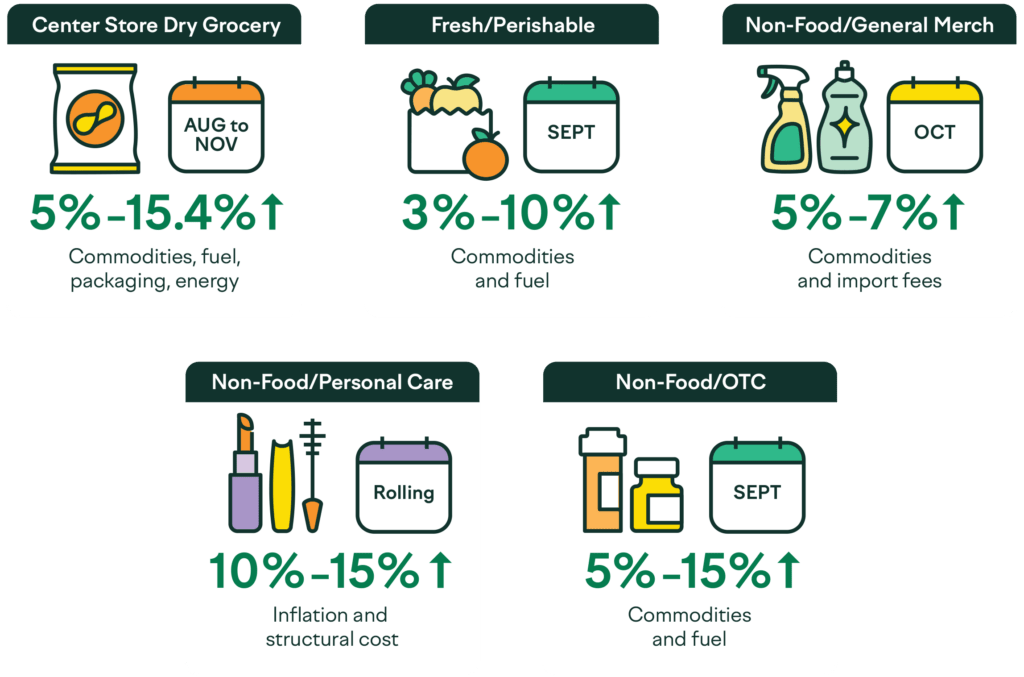
Consolidated, masked Advantage field intelligence collected across multiple client conversations, June-Sept 2026. Ranges reflect individual observed pricing actions, not category averages.
Retailers are pushing back, but many of the increases we are tracking are still moving toward implementation. Increasingly, the negotiation is shifting from whether an increase is accepted to what accompanies that acceptance.
Several tactics are showing up repeatedly in field conversations.
- Match allowances to the increase: Off-invoice allowances rise alongside list price, limiting the change in net cost.
- Delay implementation: Pushes the effective date out and preserves margin longer.
- Revisit distribution: Repeated increases can put distribution at risk, even when no single increase triggers the decision.
- Wait for enterprise approval: Banner-level decisions may pause until the broader organization acts.
Price increases are no longer standalone decisions. They are increasingly tied to funding, assortment, and category investment discussions. Shelf space and cost recovery are now part of the same negotiation.
What makes an increase stick
Justification matters more than the number. Increases tied to documented input costs have a strong case for approval, while anything that looks like a temporary or unsupported surcharge draws more immediate pushback.
Cost pressure remains broad-based. Proteins and dairy remain tight, grains and oils are moving higher, packaging costs continue to rise, and operations costs including labor, freight and warehousing remain elevated.
Field intelligence also shows suppliers becoming more targeted with pricing – taking larger increases where commodity exposure is highest, more moderate action on core lines, and protecting selected value or innovation items.
Watch for cost recovery that never shows up as price
Some suppliers are adjusting payment terms, allowances and cash discounts instead of raising list price. Terms changes may move through review more easily, but they have the same financial impact and should be treated as pricing actions.
2. TARIFFS: Refund Relief is Arriving Just as New Cost Pressures Build
About $100 billion of the $166 billion collected has been returned through tariff refund programs. Refunds generally flow to the importer of record, which means companies that imported products directly receive the reimbursement regardless of who ultimately absorbed the higher costs.
Many large retailers are also major importers and have received substantial refunds. How those funds are being used is now becoming a competitive issue, with some retailers directing proceeds toward price investment while others are reinvesting in margins or business operations.
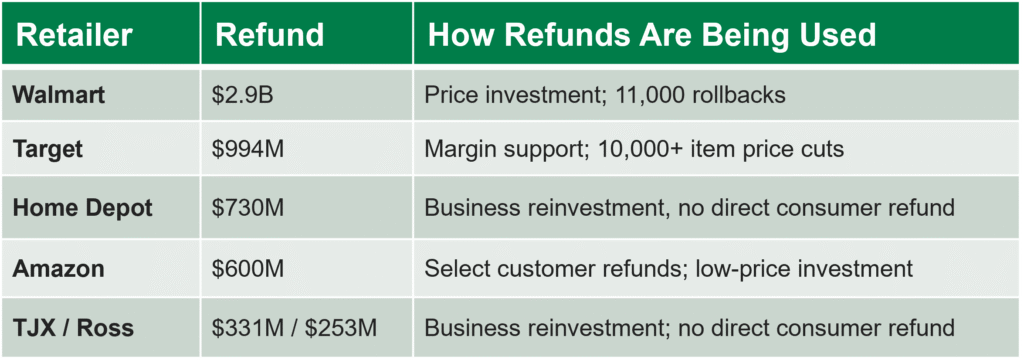
Refund figures reflect public Q2 2026 earnings disclosures and CBP filings.
The examples above show that tariff refunds are largely being retained and redeployed rather than returned dollar for dollar. While some retailers are using refunds to support lower prices, others are directing the proceeds toward margins and business investments, creating different competitive advantages across the market. Direct reimbursement to the original payer remains the exception.
Refund demands are being made in writing
By late August, some retailers were moving from verbal pressure to formal supplier letters, with requests generally falling into two categories.
Some retailers want money back. Any tariff cost that was refunded or offset must be returned as a direct credit or rebate tied to specific items, volumes and time periods. Promotional funding is being rejected because trade investment cannot be matched to the original charges. These letters also make clear that refund repayments do not settle the separate question of everyday cost.
Others want documentation. Suppliers are being asked to record refund-related funding already provided and identify future actions tied to tariff refunds.
Either way, the request is the same: proof. Retailers want a clear record item by item and period by period, and reconstructing that after the fact is proving difficult. Pressure varies by channel, so each customer requires a different response.
Where Refund Pressure Is Landing
Pressure appears strongest in Club: Expected refund amounts are being pursued directly, including written acknowledgment of money not yet received.
Regional grocery is formalizing its requirements: Written letters are specifying direct credits or rebates as the acceptable path.
Tariff-related pressure appears less pronounced in Fresh: Market leaders report little recent tariff discussion and few new refund requests.
Suppliers have grounds to push back: Refunds cover only a portion of the costs absorbed, providing support against full payback demands.
U.S. and Canada Trade Actions Add Cost Pressure in Both Directions
While tariff pressure eased through the summer, a new issue emerged in August. The US imposed 50% duties on $27.6 billion of Canadian goods across more than 550 product lines. Unlike the earlier IEEPA tariffs, these duties apply even to USMCA-compliant products, removing a protection many companies had relied on. Canada responded on September 8th with tariffs of up to 50% on an equivalent $27.6 billion of US goods.
Most of the attention has focused on higher costs coming into the United States, but manufacturers selling into Canada now face new costs going the other direction. At the highest rates, the impact goes beyond margin pressure and can make some products uncompetitive on shelf.
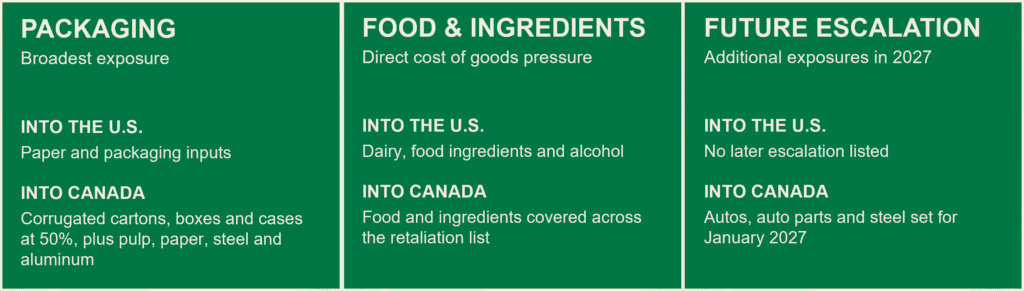
US tariff action on Canadian goods and Canadian countermeasures effective September 8, 2026.
Packaging is the broadest exposure because nearly everything ships in a box. Corrugate and aluminum cans raise costs even when the finished product is not directly tariffed. Dairy and food ingredients affect fewer suppliers, but they hit COGS directly.
What It Means, by Seat at the Table
Manufacturers face pressure on both sides. Input costs rise on packaging and ingredients, while sales into Canada may carry an added duty.
Retailers are likely to see the effect through supplier costs. The pressure may appear in cost discussions rather than as a separate tariff line.
Sourcing decisions matter now. Packaging changes and supplier shifts take time, making advance planning as important as price negotiation.
The direct impact on grocery shelves remains limited. The bigger issue is timing. Just as one round of tariff costs is being refunded, another is beginning.
3. FUEL: Higher Costs are Becoming Structural
Many retailers are rejecting separate fuel surcharges on invoices. Some reject freight increases outright and rebid the business when suppliers push. Others insist the cost come through as a list increase supported by a cost letter. Wholesalers often take the same position for a different reason: their systems cannot manage surcharges tied to individual purchase orders. As a result, notice periods have lengthened from about 60 days in the spring to 90 days today.
Field intelligence indicates that some retailers are also introducing temporary fuel-related charges for certain supplier arrangements, with exceptions in particularly price-sensitive categories. The move has drawn supplier pushback and highlights how fuel costs are increasingly being managed through structural charges rather than one-off negotiations.
The shift is clearest among distributors and logistics providers, where fuel costs are increasingly embedded in published rater schedules rather than negotiated account by account. The examples below are drawn from public schedules rather than field intelligence.
Published Surcharge Rates
UNFI: A publicly posted fuel surcharge tied to the weekly EIA diesel benchmark. The charge increases in $5 increments as diesel rises; at current national diesel levels, the published schedule corresponds to $75 per delivery, although the applicable charge may vary by DC region.
Amazon: A published 3.5% fuel and logistics surcharge, alongside its full logistics network now open to any business.
The EIA national diesel average reached $5.96 per gallon for the week of September 7th. Private pump-price trackers pushed the national average above $6 later in the week. Published LTL surcharge schedules ranged from 48% to 51% of the line-haul rate, up from roughly 30% in January.
Published LTL fuel surcharges have risen from roughly one-third of the line-haul rate to more than one-half in eight months. With volume concentrated among a handful of distributors, higher fuel costs move quickly through the system and can affect a large number of stores. Fuel costs are increasingly being built into retailer, distributor and logistics operating models rather than negotiated one shipment at a time.
The Big Picture
The cost pressure that intensified in May has not eased; it is becoming part of the operating model. Manufacturers continue to absorb higher input costs while facing pressure on outbound logistics, and price negotiations increasingly extend beyond the list increase to timing, funding and other concessions.
What to Watch
Effective dates will determine how much pricing actually lands
- Retailers are delaying acceptance even when they approve an increase. Track when new costs take effect, not when suppliers announce them. The difference directly affects how long manufacturers must absorb higher input costs.
Retailer concessions could offset much of the increase
- Larger allowances, added category investment, and other funding requests are becoming part of price negotiations. A list increase can be approved while the supplier’s net recovery remains limited.
Tariff refunds are creating a new documentation standard
- Formal letters are moving the conversation toward item-level proof, direct credits and defined time periods. The next signal is whether national retailers adopt the same requirements now appearing in Regional Grocery and Club.
Record diesel prices can move through the system quickly
- Fuel surcharges increasingly reset through published indexes and rate schedules rather than account-by-account negotiations. Changes in diesel can therefore flow into distributor and freight costs within days.
The Advantage Perspective
The cost pressures that intensified this spring are settling into the operating model. Price increases are moving through the market; tariff refunds have opened a new negotiation over who ultimately receives the benefit, and elevated fuel costs are being embedded in freight and logistics economics.
For manufacturers and retailers, the question is less about whether costs are moving and more about how those costs, and any subsequent relief, are shared across the supply chain.
Conditions continue to move week to week. Advantage teams are tracking pricing actions, customer responses and cost recovery in real time to help clients distinguish temporary volatility from changes that require a longer-term response.
Sources: Cleveland Research Company; Circana, CPG Demand Signals Report, August 27, 2026; Mintel; US Energy Information Administration, Gasoline and Diesel Fuel Update, September 9, 2026; AAA and GasBuddy national fuel price reporting, September 2026; Federal Reserve Bank of St. Louis, “Tariff Effects on Inflation Stabilize in Recent Months,” August 18, 2026; Cleveland Fed SoFIE; US Customs and Border Protection, IEEPA Duty Refunds and CAPE program updates; public court filings and Q2 2026 company earnings disclosures used for refund amounts; Department of Finance Canada, countermeasures and product schedules effective September 8, 2026; Circana and CDC reporting used for CPG volume and Cyclospora context; Advantage Solutions consolidated pricing action feedback and field intelligence, April through August 2026.
Publicly published rates: UNFI fuel index surcharge schedule; Amazon fuel and logistics surcharge reporting; published LTL carrier fuel surcharge schedules from XPO, TForce Freight, Roadrunner and Southeastern Freight Lines for the weeks of August 31 and September 7, 2026.
Companies named in this brief appear only where the information comes from publicly published rate schedules, public earnings disclosures or regulatory filings. All client, retailer and supplier identities drawn from field intelligence are masked. Confidential, do not distribute externally without approval. • Advantage360™ | YourADV.com